How Much Does Magazine Design Cost?
The cost of designing a magazine can vary widely.
A simple newsletter-style publication will cost much less than a highly designed magazine with custom layouts, photography, infographics, advertising pages and print management.
The real answer depends on the size of the publication, the amount of content, the quality of the supplied material and how much creative work is needed.
This guide explains what affects the cost and how to budget properly for your next magazine.
The short answer
As a rough guide, professional magazine design can range from:
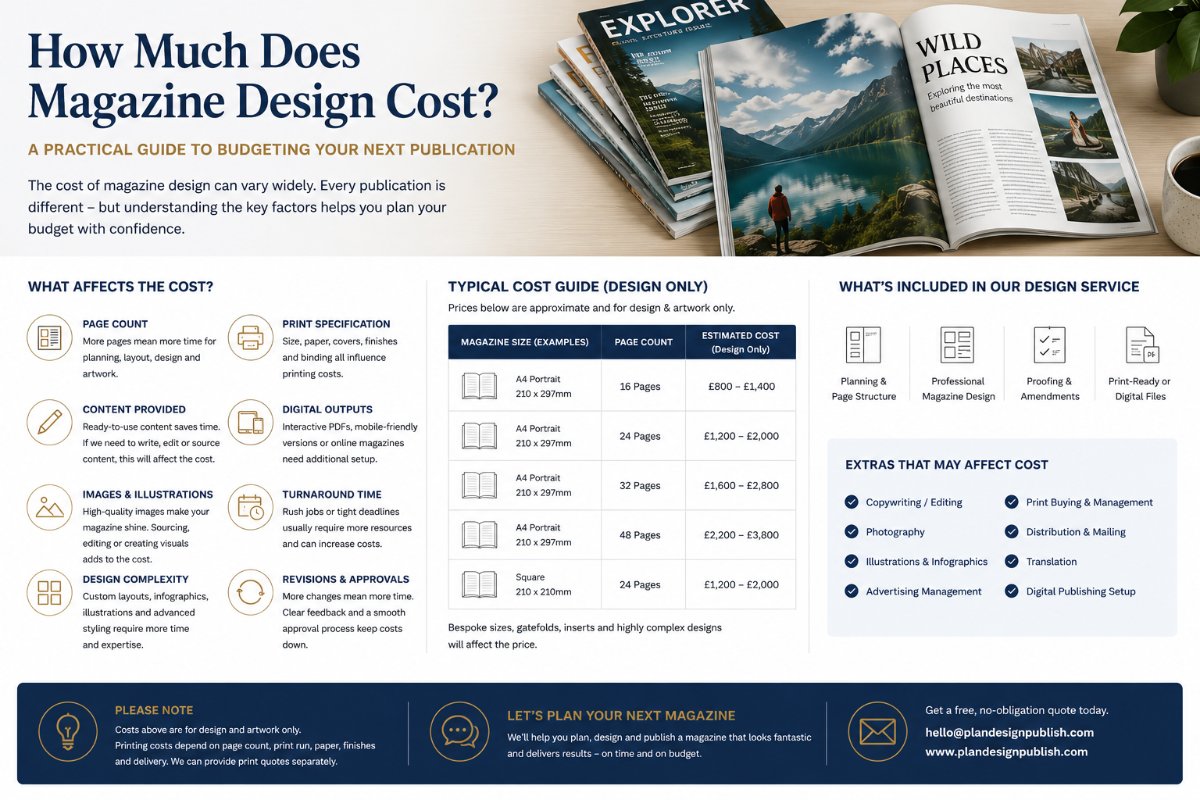
£800–£1,400 for a simple 16-page publication
£1,200–£2,000 for a 24-page magazine
£1,600–£2,800 for a 32-page magazine
£2,200–£3,800+ for a 48-page magazine
£4,000+ for larger, more complex or highly designed publications
These figures are for design and artwork only.
They do not usually include printing, photography, copywriting, advertising sales, mailing, distribution or advanced digital publishing.
Every project is different, but these ranges give you a realistic starting point.
1. Page count
Page count is usually the biggest factor.
More pages mean more planning, layout, image work, proofing and final artwork. A 16-page magazine is not simply half the work of a 32-page magazine, but the number of pages does have a major impact on cost.
Typical page counts include:
16 pages
24 pages
32 pages
40 pages
48 pages
64 pages
80+ pages
The more pages you have, the more important planning becomes.
A clear flatplan helps control the page count before design begins, which keeps costs under control.
2. Content readiness
The state of the content has a big effect on price.
If all copy, images, adverts and captions are supplied correctly, the project will be faster and cheaper.
If the content needs editing, rewriting, sourcing, restructuring or chasing, the cost will increase.
Before asking for a quote, it helps to know:
how many articles are included
whether the text is final or draft
whether images are available
whether captions and credits are ready
whether adverts are supplied correctly
who is responsible for proofreading
who gives final approval
The cleaner the content, the smoother the design process.
3. Design complexity
Not all magazine pages are equal.
Some pages may use a simple repeatable layout. Others may need custom design, complex grids, feature openers, cut-outs, infographics or detailed image treatment.
A straightforward members’ magazine or newsletter may use a consistent template throughout.
A high-end lifestyle, travel or arts magazine may need more creative design across each section.
Design complexity can include:
bespoke page layouts
custom typography
feature openers
image-led spreads
infographics
maps
pull quotes
timelines
advert design
complex tables
charts
illustration
brand styling
The more individual design attention each page needs, the higher the cost.
4. Image quality and preparation
Images can make or break a magazine.
If professional, high-resolution images are supplied, design is usually more efficient. If images are low quality, inconsistent or missing, extra work may be needed.
Image-related costs may include:
sourcing stock photography
commissioning photography
editing supplied images
retouching
colour correction
cropping
background removal
image restoration
caption writing
preparing images for print
For print, image resolution matters. A photograph that looks fine on a screen may not be suitable for an A4 printed page.
Poor images often create extra work and can reduce the quality of the final publication.
5. Print or digital format
A printed magazine and a digital magazine are not the same thing.
A print-ready magazine needs correct bleed, margins, colour settings, image resolution and export specifications. It also needs to be prepared according to the printer’s requirements.
A digital version may need:
reduced file size
clickable links
screen-friendly formatting
accessibility improvements
web article versions
social media crops
email newsletter extracts
SEO titles and descriptions
If you need both print and digital versions, this should be planned from the beginning.
It is usually more cost-effective to design with both outputs in mind rather than adapting everything at the end.
6. Revisions and approvals
Revisions affect cost.
Most professional design quotes include a reasonable number of amendment rounds. However, costs can rise when changes are extensive, late or unclear.
Common causes of extra revision time include:
copy changes after layout
replacing images late
changing article order
adding new pages
moving adverts
multiple people giving conflicting feedback
unclear approval responsibility
design changes after final artwork
The best way to control revision costs is to agree a clear workflow before design begins.
One nominated person should collect feedback, organise comments and confirm approvals.
7. Printing costs
Printing is usually quoted separately from design.
Print cost depends on:
page count
quantity
paper stock
cover stock
binding method
size
finishes
delivery
turnaround time
A short-run magazine on standard paper will cost much less than a high-volume publication with a heavier cover, special finishes and multiple delivery points.
Typical print considerations include:
A4 or custom size
portrait or square format
saddle stitch or perfect binding
gloss, silk or uncoated paper
cover weight
inside paper weight
lamination
spot UV
foil blocking
delivery and fulfilment
If printing is required, it is best to discuss this early. The design may need to be adapted for the chosen specification.
8. Optional extras
Magazine projects often need more than design.
Additional services may include:
copywriting
editing
proofreading
photography
image sourcing
advert design
print buying
distribution support
website upload
blog conversion
social media graphics
email newsletter design
digital publishing setup
These extras should be quoted separately so the budget is clear.
A well-managed project separates the core design cost from optional production and publishing support.
Typical magazine design cost guide
Here is a simple guide for design and artwork only:Small newsletter or mini magazine
Small newsletter or mini magazine 12–16 pages £600–£1,400
Standard magazine 24 pages £1,200–£2,000
Medium magazine 32 pages £1,600–£2,800
Larger magazine 48 pages £2,200–£3,800
Complex magazine or publication 64+ pages £4,000+
These are guide prices only. The final cost depends on content, complexity, schedule and production requirements.
How to reduce magazine design costs
The best way to reduce cost is not to make the design worse. It is to make the process better.
You can reduce unnecessary design time by:
creating a clear brief
agreeing the page count early
preparing a flatplan
supplying final copy
providing high-quality images
naming files clearly
confirming advert sizes
limiting late changes
using one person to manage feedback
approving sections on schedule
Good organisation saves money.
A well-planned magazine is usually cheaper to produce than a rushed magazine, even if the final page count is the same.
What should a quote include?
A professional magazine design quote should clearly explain what is included.
Look for details such as:
number of pages
format and size
design concept
page layout
image preparation
number of revision rounds
print-ready PDF
digital PDF
print liaison, if required
estimated schedule
what is not included
extra hourly or day rate for additional work
This avoids confusion later.
A clear quote protects both the client and the designer.
The bottom line
Magazine design cost depends on planning, content, page count and complexity.
A small, well-organised publication may be relatively affordable. A large, image-heavy or highly designed magazine will naturally require a bigger budget.
The most important thing is to plan properly before design begins.
That means agreeing the purpose, audience, page count, flatplan, content requirements, print specification and digital outputs early.
Good planning gives you a better magazine and a more accurate budget.
Need a quote for magazine design?
Plan Design Publish helps businesses, publishers, charities and organisations plan, design and produce professional magazines, newsletters, brochures and annual reports.
We can help with flatplanning, page structure, design, artwork, print-ready files and digital publishing.
Send us your page count, brief and publication type, and we’ll help you work out a realistic budget.