Print Magazines Are Declining — But Not Everywhere
How non-English markets are keeping magazine publishing alive
In the UK and US, it is easy to assume that print magazines are in permanent decline. Retail sales are down, advertising has moved online, paper and postage costs have risen, and many once-powerful mass-market titles now feel like relics of another media age.
But that is only part of the story.
Look beyond the English-speaking world and the picture becomes more complex. Print is still under pressure almost everywhere, but in many countries magazine publishing is not simply collapsing. It is changing shape. In some regions, especially where strong local languages, regional identity and growing middle-class audiences remain powerful, magazines still have cultural and commercial life.
The future of print may not be mass-market, monthly and disposable. It may be local, premium, specialist, collectible and hybrid.
The global magazine market is still worth watching
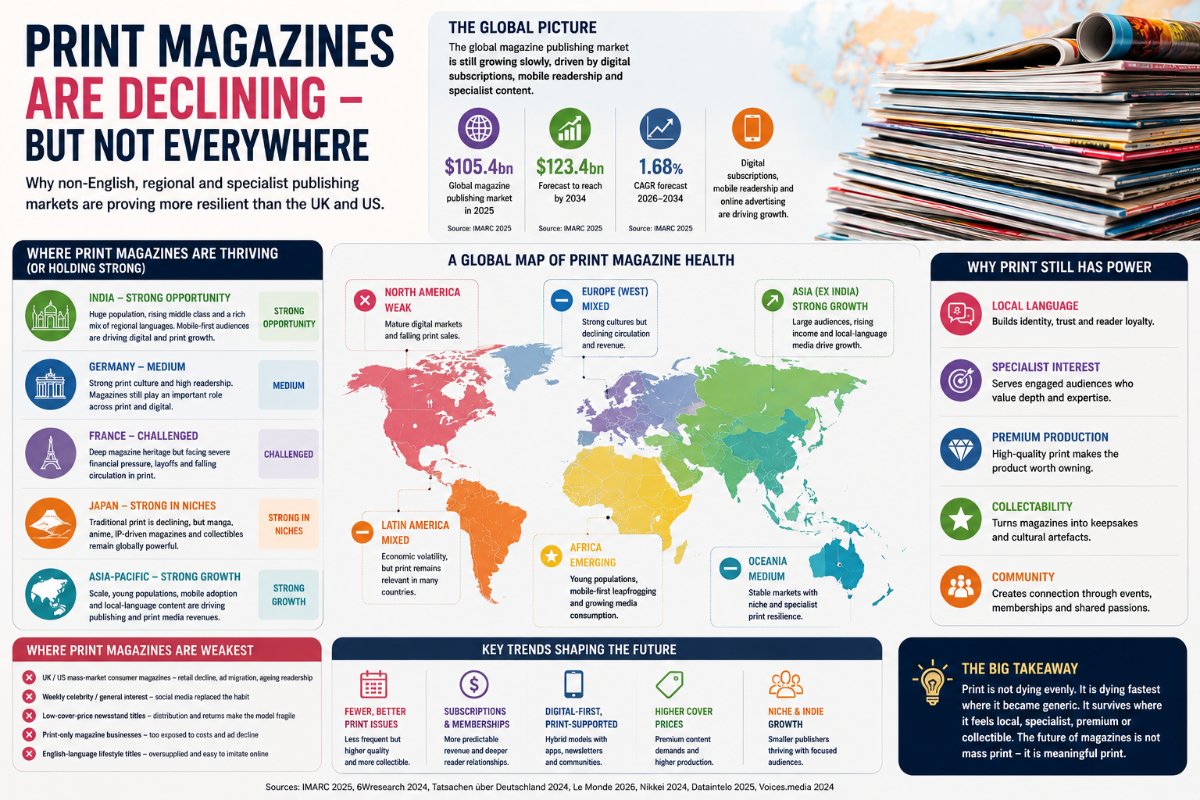
The global magazine publishing market was estimated at $105.4 billion in 2025, with forecasts suggesting it could reach $123.4 billion by 2034. That is not explosive growth, but it is not extinction either. The expected compound annual growth rate is modest, at around 1.68%, and much of that growth is being driven by digital publishing, smartphone readership, online advertising and subscriptions.
This distinction matters.
The old print model is struggling. The wider magazine model is adapting.
Magazines are no longer just printed objects sold on newsstands. They are brands, communities, digital products, newsletters, apps, social channels, live events, paid memberships and premium print editions.
Print still has a role, but it has to justify itself.
Why English-language print has been hit so hard
The UK and US are among the most difficult markets for traditional print magazines because the shift to digital happened early and aggressively.
Readers moved to websites, social media, YouTube, newsletters and apps. Advertisers followed them. Supermarkets and newsagents reduced range. Distribution became more expensive. Younger audiences lost the weekly or monthly habit of buying general-interest magazines.
Print category & Problem
Mass-market weeklies - Social media replaced celebrity and lifestyle updates
Low-price newsstand titles - Distribution and returns damage profitability
General-interest magazines - Too much free competition online
Print-only businesses - Exposed to paper, postage and retail decline
English-language lifestyle titles - Oversupplied and easy to imitate online
This is why hobby magazines, manga, luxury fashion editions, craft titles, religious publications, regional magazines, design journals and indie magazines often feel more resilient than general-interest weeklies.
They are not trying to be everything to everyone.
The future is not mass print
The future of magazine publishing is unlikely to look like the 1990s or early 2000s.
The strongest publishers will probably use print more selectively:
Fewer issues.
Better paper.
Higher cover prices.
Stronger design.
More subscriptions.
More direct reader relationships.
More digital support around the printed product.
Print becomes the flagship, not the whole business.
What this means for independent publishers
For independent publishers, this is not bad news. In some ways, it is an advantage.
Large publishers are often trapped by legacy costs, large print runs, retail dependence and declining advertising models. Smaller publishers can be more focused. They can serve a niche, build direct relationships and use print as a premium product rather than a mass commodity.
The opportunity is not to copy old magazine publishing.
The opportunity is to create something readers feel is worth keeping.
Conclusion
Print is not dying evenly.
It is dying fastest where it became generic: mass-market, low-value, disposable and easily replaced by digital feeds.
But it survives where it feels local, specialist, beautiful, useful or collectible. That is why non-English and regional-language markets matter. They remind us that publishing is not just about format. It is about culture, identity and trust.
The future of magazines will not be built by pretending nothing has changed.
It will be built by understanding where print still has meaning — and designing around that.